HOA Pressure Washing in Clark County: Keeping Your Community Clean Year-Round

A homeowners association takes care of the spaces everyone shares: the entrance people drive through every day, the sidewalks kids walk to the bus, the mail kiosk, the clubhouse. In Vancouver, Camas, Battle Ground and across Southwest Washington, those spaces face the same thing every home does here: months of rain, shade from firs and cedars, and moss, algae and grime that build up faster than most people expect.

Here’s what HOA pressure washing in Clark County covers, why it’s worth planning for, and how a board can set up recurring or seasonal service with Mountain View Pressure Washing And Softwash.

What HOAs need cleaned

Every community is different, but most shared areas fall into a few groups:

  • Community entrances and monument signs: The entrance is the first thing residents and visitors see. Monument signs, stone or brick walls and entry pavers collect green growth, dirt and water stains. Signs and painted surfaces need a gentle soft wash, not high pressure.
  • Common areas: Courtyards, seating areas, playground surrounds and walking paths get heavy use and plenty of shade.
  • Clubhouses and amenity buildings: Siding, trim, entry walkways and patios around a clubhouse or pool building get the same algae and mildew streaks as a home. See our house soft washing in Vancouver page for how we handle siding.
  • Mail kiosks: Shared mailbox stations and the concrete pads around them are touched and walked on daily, and they often sit under trees.
  • Sidewalks and walkways: Long runs of shared sidewalk are where slick moss and algae matter most.
  • Parking areas: Concrete parking pads, curbs and guest parking collect oil drips, tire marks and organic buildup.
  • Roofs: Clubhouse, pavilion and amenity roofs grow moss in our climate. Roofs get a low-pressure soft wash. Learn more about roof washing in Vancouver.
  • Gutters: Clogged gutters on shared buildings overflow onto walkways and entries. See gutter cleaning in Vancouver.
  • Fences: Perimeter and privacy fences along the community turn gray and green over time and can be soft washed at low pressure to brighten them up.

Why community pressure washing pays off for the HOA

Curb appeal

Clean entrances, sidewalks and common areas make the whole neighborhood look cared for. When shared spaces look neglected, it reflects on every home in the community, no matter how well each owner keeps up their own house.

Protecting property values

Part of an HOA’s job is protecting the look and condition of the community. Keeping shared surfaces clean, and keeping moss and algae from holding moisture against concrete, wood and roofing, is part of good long-term upkeep.

Resident satisfaction

Residents notice when the entrance is bright and the walkways are clean. Visible maintenance shows that dues are going toward the spaces people actually use.

Slip safety

Wet algae and moss on concrete can be as slick as ice, and shared sidewalks, steps and mail kiosk pads get walked on by residents of every age. Fall and winter are the worst time, when surfaces stay wet and it gets dark early. Our post on what really makes driveways slippery explains why the same growth makes walkways a hazard.

Seasonal maintenance in the PNW rain

From fall through spring, Clark County stays damp for long stretches. Growth that starts in October can be well established by spring. Planning cleaning around the seasons, instead of waiting until something looks bad, keeps shared areas in good shape all year.

HOA soft washing Clark County communities can trust: why method matters

Not every surface should get high pressure. Monument signs, painted trim, siding, roofs and some decorative stone can be damaged by too much pressure. Soft washing uses low pressure with a cleaning solution to remove algae, mildew and moss, then rinses it away. Hard surfaces like concrete sidewalks and parking pads get pressure washing, often with a surface cleaner for an even result. Matching the method to each surface is the key to safe HOA pressure washing Vancouver WA communities can count on, and the same goes for HOA soft washing Clark County-wide.

How recurring or seasonal HOA service works

Here’s how a board or property manager can set up recurring HOA pressure washing in Vancouver, WA or anywhere around Clark County with us:

  1. A walkthrough and free estimate. Owner Dakota Grindland walks the community with a board member or property manager, looks at the shared areas and problem spots, and gives you a quote.
  2. An agreed scope. Together we decide which areas are included: entrance, sidewalks, mail kiosks, clubhouse, roofs, gutters, fences or parking areas. The board chooses what fits its needs and budget.
  3. An agreed schedule. Many communities in our climate make sense on a spring and fall rhythm: a spring cleaning to clear winter growth and a fall cleaning before the heavy rain. The board sets the timing that works for the community.
  4. Notice to residents. Before each visit, the board or manager lets residents know the date and which areas will be cleaned, so cars, doormats and kids’ toys can be moved out of the way.
  5. The cleaning. Each surface gets the right method: soft washing for roofs, siding, signs and painted surfaces, and pressure washing for concrete.
  6. Cleanup. We rinse away the debris so it isn’t left on lawns, walkways or landscaping.

If gutters are part of your scope, our fall gutter cleaning guide covers why timing matters in Clark County.

Mountain View Pressure Washing And Softwash is licensed & insured and locally owned & operated.

Homeowners association cleaning near me

Searching for homeowners association cleaning near me? Mountain View Pressure Washing And Softwash serves HOAs and communities across Vancouver and Clark County, including Camas, Washougal, Battle Ground, Ridgefield and La Center. Explore our services:

HOA pressure washing FAQ

What areas of an HOA can be pressure washed or soft washed? Entrances and monument signs, sidewalks and walkways, mail kiosks, clubhouses, common areas, parking areas, roofs, gutters and fences. The board decides which areas are included.

How often should an HOA schedule community pressure washing? It depends on shade, trees and how much each area is used. In Clark County, many communities find a spring and fall schedule fits the rainy season well. We can talk through timing during your walkthrough.

Is soft washing safe for monument signs and painted surfaces? Yes. Soft washing uses low pressure with a cleaning solution, which is the right approach for signs, painted trim, siding and roofs where high pressure could cause damage.

Do residents need to do anything before the cleaning? The board or property manager usually sends a notice with the date and areas being cleaned, so residents can move cars, doormats and other items out of the way.

Can you work with our property manager instead of the board? Yes. We’re happy to coordinate the walkthrough, estimate and scheduling with whoever handles maintenance for the community.

How do we get a quote? Call Dakota at (360) 852-5589 to set up a walkthrough and free estimate.

Get a free HOA estimate

HOA boards and property managers: ready to get your community’s shared spaces clean before the rain sets in? Mountain View Pressure Washing And Softwash offers free walkthroughs and estimates for recurring or seasonal service.

Call Dakota at (360) 852-5589.
Get a free estimate

Pressure washing in Vancouver · Roof washing in Vancouver

Commercial Pressure Washing and Soft Washing in Clark County

Your building is the first thing customers, tenants and visitors see. In Vancouver, Camas, Battle Ground and across Clark County, our wet Pacific Northwest weather means that first impression can turn green, gray or streaked faster than most business owners expect. Moss, algae, mildew and everyday grime build up on siding, entryways and walkways all fall and winter.

For other commercial options, see our commercial pressure washing in Vancouver page.

Here’s what commercial pressure washing and soft washing are, what a business property usually needs cleaned, and why choosing the right method matters for your surfaces.

Pressure washing vs. soft washing: what’s the difference?

Both methods clean exterior surfaces, but they work in different ways:

  • Pressure washing uses high-pressure water to blast away dirt, grime, gum, moss and buildup. It’s the right tool for hard, durable surfaces like concrete sidewalks, walkways and dumpster pads.
  • Soft washing uses low-pressure water with cleaning solutions that break down algae, mildew, moss and organic staining. The solution does the work, so the surface isn’t hit with force. It’s the safer choice for siding, painted surfaces, stucco and roofs.

Most commercial properties need a mix of both. For a deeper look, read our guide to pressure washing vs soft washing.

What businesses need cleaned

Every property is different, but these are the areas that tend to need attention:

  • Building exteriors and siding: Green and black streaks from algae and mildew show up on the shady sides of buildings. Our building washing in Clark County uses a soft wash that lifts that growth without damaging the siding.
  • Storefronts and entryways: Your entrance is where customers form an opinion. Storefront cleaning in Vancouver, WA focuses on the doorways, walls and surfaces people see up close.
  • Sidewalks and walkways: Foot traffic grinds dirt, gum and spills into concrete, and shade and rain add moss and algae.
  • Concrete areas: Patios, entry pads, loading areas and other concrete surfaces collect stains and slick growth.
  • Dumpster pads: These get grimy and smelly quickly. Regular cleaning keeps them more sanitary and less of an eyesore.
  • Roof soft washing: Moss and algae on a roof hold moisture against the surface. A soft wash treats that growth at low pressure. See our roof washing in Vancouver page.
  • Gutters: Fir needles and leaves clog gutters fast here, which can lead to overflow down walls and onto walkways. Learn more about gutter cleaning in Vancouver, or read when to clean your gutters in Clark County.

Have something else in mind? Ask us.

Why soft washing matters for commercial surfaces

Commercial buildings often have surfaces that high pressure can hurt. That’s why soft washing in Vancouver matters so much for business properties:

  • Painted surfaces: High pressure can chip, peel or etch paint. A soft wash cleans without stripping the finish.
  • EIFS and stucco: These finishes are popular on commercial buildings, and they can be damaged by high pressure. Forcing water into or behind them can cause problems. A low-pressure soft wash is the gentler approach.
  • Signage: Signs, lettering and lighted displays can be scratched, faded or loosened by a strong spray. Soft washing lets us clean around them with care.
  • Delicate finishes and trim: Wood trim, metal accents and older materials need a lighter touch to avoid gouging or marking.

Soft washing also treats algae, mildew and moss at the root, so the surface stays cleaner longer than a rinse alone. It’s the same approach we use for house soft washing in Vancouver, applied to commercial surfaces.

The benefits for business owners and property managers

Keeping a commercial property clean isn’t just about looks. Here’s what regular cleaning helps with:

  • Curb appeal: A clean building looks cared for. Streaked siding and stained sidewalks can make even a well-run business look neglected.
  • A good first impression: Customers, tenants and visitors notice a clean entrance. It tells them you pay attention to details.
  • Slip safety on walkways: In the fall and winter rain, moss and algae on concrete can get as slick as ice. Keeping walkways and entries free of slick growth helps reduce slip hazards for everyone who walks on them. Our post on what really makes a driveway slippery explains how that growth works, and the same goes for business walkways.
  • Protecting your surfaces: Moss, algae and grime hold moisture against siding, roofs and concrete. Removing them helps protect the materials you’ve already invested in.

How commercial cleaning works with us

Here’s what to expect when Mountain View Pressure Washing And Softwash handles commercial pressure washing Clark County businesses need:

  1. A free estimate. We look at the building, the entrances, walkways and problem areas, and talk about what you want cleaned.
  2. A plan for each surface. We match the method to the surface: soft washing for siding, stucco, painted areas and roofs, and pressure washing for concrete.
  3. Scheduling around your business. We’ll work with you on a time that keeps disruption low for your customers and staff.
  4. Careful prep. We protect plants, signage and sensitive areas before we start.
  5. The cleaning. Siding, entries, walkways and other areas get cleaned using the right method for each.
  6. A final walk-through. We check the results with you to make sure you’re happy.

Want it to stay clean? Ask about recurring service so your property looks good all year, not just after a one-time cleaning.

Serving businesses across Clark County

Searching for commercial soft washing near me? Owner Dakota Grindland runs Mountain View Pressure Washing And Softwash and is licensed & insured. We serve Vancouver and the surrounding area, including Camas, Washougal, Battle Ground, Ridgefield and La Center. Start with our Vancouver pressure washing page, or see our driveway cleaning in Vancouver service for concrete work.

Commercial pressure washing FAQ

What’s the difference between commercial pressure washing and soft washing? Pressure washing uses high-pressure water for hard surfaces like concrete. Soft washing uses low pressure and cleaning solutions for siding, stucco, painted surfaces and roofs. Most commercial properties need both.

Is soft washing safe for stucco and EIFS? Soft washing is the gentler choice for stucco and EIFS, because it doesn’t rely on high pressure that can damage those finishes. We’ll look at your building’s exterior during the estimate.

Can you clean around our signs? Yes. We take care around signage and lettering and use a low-pressure approach near delicate surfaces.

Do you offer recurring service? Ask us about it. Recurring cleaning is a good fit for businesses that want entries, walkways and siding to stay clean through the wet months.

Can you work around our business hours? We’ll talk about timing during your estimate and try to schedule at a time that keeps disruption low.

How often should a commercial property be cleaned? It depends on shade, trees, foot traffic and the type of surfaces. Shady buildings and busy walkways in Clark County usually need it more often. Ask during your estimate.

Get a free estimate

Ready for a cleaner storefront, building or walkway? Mountain View Pressure Washing And Softwash offers free estimates for commercial pressure washing in Vancouver, WA and soft wash service across Clark County. Licensed & insured, locally owned & operated.

Call Dakota at (360) 852-5589.

Get a free estimate

Vancouver pressure washing · Soft washing in Vancouver

What Really Makes Your Driveway Slippery in Clark County

When a driveway in Vancouver, Camas or Battle Ground turns slick in the fall, it usually isn’t just wet leaves or rain. The real culprits are living things that grow right on the concrete: moss, algae, lichen and fungus. In our wet Pacific Northwest climate, they have months to spread, and they’re at their slickest exactly when you’re walking on them in the rain.

Here’s what’s actually growing on your driveway, why it’s dangerous, and how professional driveway cleaning in Clark County takes care of it.

Why Clark County driveways are made for green growth

Three things work together here:

  • Rain: From fall through spring, Southwest Washington stays damp for long stretches. Concrete that rarely dries out is a perfect place for things to grow.
  • Shade: Driveways along the north side of a house, under firs and cedars, or next to a fence or hedge get little direct sun. Shade keeps the surface wet even between storms.
  • Porous concrete: Concrete looks solid, but it’s full of tiny pores. Water, dirt and spores settle into them, giving growth a foothold that a garden hose won’t reach.

Add in fir needles and leaves breaking down on the surface, and you have plenty of food and moisture all season.

The four real culprits

Moss

Moss loves the shady, damp edges of a driveway, the cracks and expansion joints, and anywhere needles and soil collect. It holds water like a sponge, so even on a dry afternoon a mossy patch can stay wet and soft underfoot. Moss removal on a driveway matters because it doesn’t just sit on top. Its roots work into cracks and joints, and as it holds moisture against the concrete it can help widen them over time.

Algae

Algae is the green or black film that makes concrete look dingy. It’s thin, so people often don’t notice it until someone slips. When algae gets wet, it turns slimy, and that film is one of the most common reasons for a slippery driveway in the wet months. Algae removal on a driveway takes more than rinsing, because it grows back quickly from what’s left in the pores.

Lichen

Lichen shows up as crusty, flat spots, often gray, white, yellow or pale green. It’s a partnership between a fungus and algae, and it grips the surface tightly. Lichen is less slick than algae when it’s dry, but it traps moisture and dirt, and it’s stubborn. It can also leave marks behind if it’s only partly removed.

Fungus and mildew

Dark spots and blotches on concrete are often mold, mildew or other fungal growth, especially in shady spots and near downspouts. Like algae, it gets slippery when wet and can stain the surface.

Why it’s a real driveway slip hazard

A driveway is one of the most-used surfaces at your home. Everyone walks on it: you, your kids, older family members, guests, delivery drivers. That’s why the growth matters:

  • Slips and falls: Wet algae and moss can be as slick as ice. It’s worst in fall and winter, when the surface stays wet and it gets dark early, so you can’t always see the slick patches.
  • Slopes make it worse: Many driveways in Clark County have a grade. A slick film on a slope is a bigger driveway slip hazard than the same film on flat ground.
  • Surface damage: Moss and other growth hold water against concrete and work into cracks and joints. Over time, that can contribute to wear and staining.
  • Curb appeal: A green or black driveway makes the whole property look neglected, even if the house itself is clean.

How professional driveway cleaning removes it

Here’s what to expect when Mountain View Pressure Washing And Softwash handles driveway cleaning in Vancouver, WA and around Clark County:

  1. A free estimate. We look at the driveway, walkways and problem areas and give you a quote.
  2. Clearing loose debris. Needles, leaves and loose moss come off first so the cleaning can reach the concrete.
  3. Surface cleaner pressure washing. Pressure washing a driveway with a rotating surface cleaner gives an even clean across the concrete and helps avoid the stripes and wand marks you can get from cleaning by hand.
  4. Post-treatment where it makes sense. A cleaning solution applied after washing, or a soft wash approach where appropriate, helps treat the growth left in the pores so it’s slower to come back. Curious about the difference? Read pressure washing vs soft washing.
  5. Cleaning up after. We rinse away the debris so it isn’t left on your lawn or walkway.

Concrete cleaning won’t change the weather, and growth can come back over time in shady, wet spots. Keeping the driveway cleared of needles and leaves and making sure downspouts aren’t dumping water onto it both help. Our fall gutter cleaning guide explains why overflowing gutters often end up soaking the driveway below. And if moss is growing on your driveway, check the roof too. See our Battle Ground roof moss soft wash.

Mountain View Pressure Washing And Softwash is licensed & insured and locally owned & operated.

Driveway cleaning around Clark County

Searching for driveway cleaning near me? Owner Dakota Grindland cleans driveways all over Clark County. Find your area:

Driveway cleaning FAQ

How can I tell if my driveway is a slip hazard? Look for green or dark patches, a slimy film after rain, or spots that stay damp long after the rest of the driveway dries. Those are the areas where moss, algae, lichen or fungus are growing and where slips are most likely.

Why is my driveway slippery only in the fall and winter? Growth is there all year, but rain keeps it wet in the colder months. Wet algae and moss are far slicker than dry, and shorter days make the slick spots harder to see.

Will pressure washing alone remove moss and algae? Pressure washing removes what’s on the surface. A post-treatment helps deal with growth left in the concrete’s pores so it’s slower to return.

Can pressure washing damage my concrete? Too much pressure or the wrong technique can etch concrete. A surface cleaner used correctly gives an even clean without gouging or striping.

How often should I have my driveway cleaned? It depends on shade, trees and drainage. Shady driveways under firs and cedars tend to need it more often than sunny, open ones. Ask during your estimate.

Do you clean walkways and patios too? Yes. Walkways, steps and patios grow the same moss and algae, and they can be just as slippery. Ask about them when you request your estimate.

Get a free estimate

Ready to get rid of that slippery driveway before the heavy rain? Mountain View Pressure Washing And Softwash offers free estimates.

Call Dakota at (360) 852-5589.

Get a free estimate

Driveway cleaning service · Driveway cleaning in Camas

When to Clean Your Gutters in Clark County (and Why Fall Matters Most)

If you live in Vancouver, Camas, Battle Ground, Ridgefield, Washougal or La Center, you know what fall looks like from your driveway: wet leaves on the lawn, fir needles on the walkway and a little more green on the roof each week. A lot of that ends up in your gutters.

Ready to book? See our gutter cleaning service page for what is included.

Gutters are easy to forget because you can’t see inside them from the ground. Usually you only notice there’s a problem when water starts spilling over the edge during the first big rain.

Here’s when to clean your gutters in Clark County, why they fill up so fast this time of year, and what a professional gutter cleaning involves.

The short answer: October through December

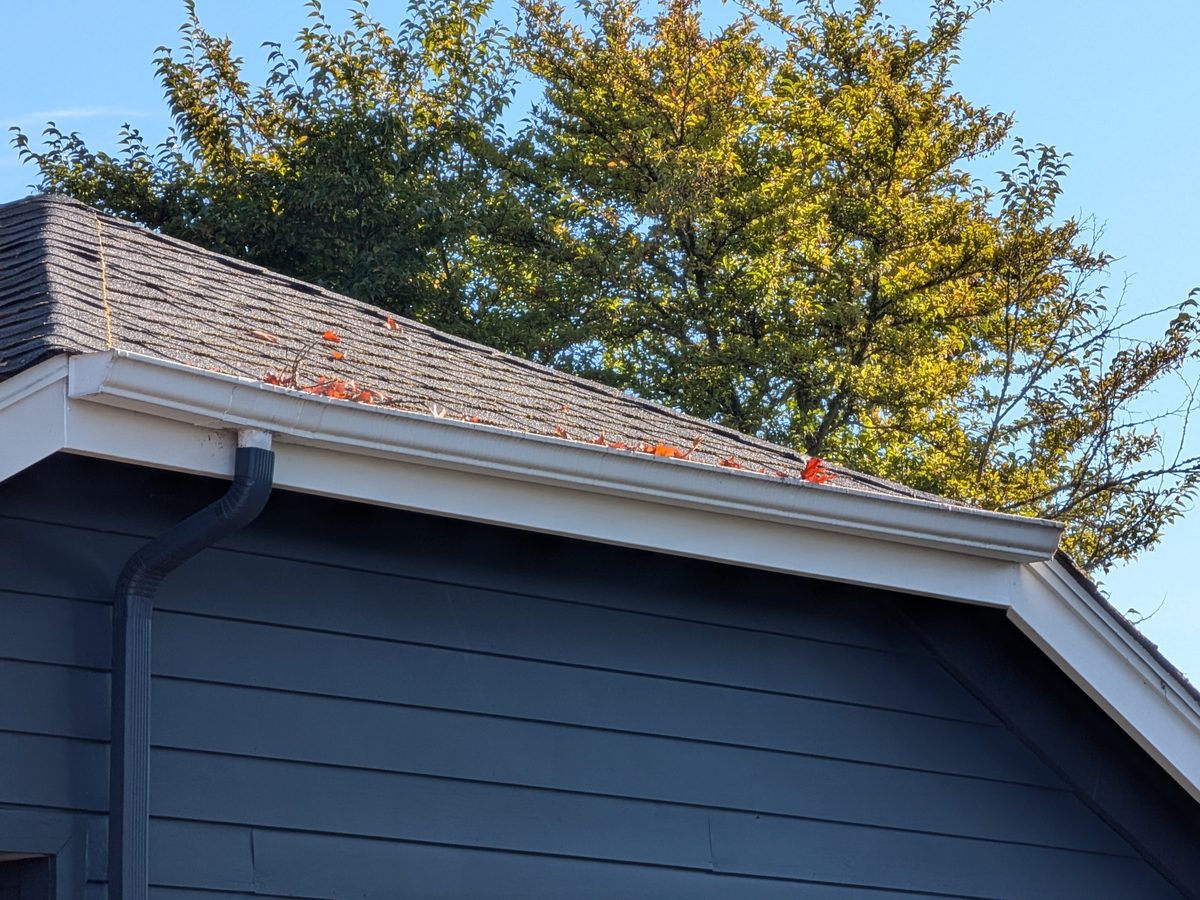
Fall leaves sitting in a white gutter along a roofline before cleaning

In Southwest Washington, most of the debris that clogs gutters comes down in fall. Leaves drop, wind and storms knock needles loose, and the rainy season starts up again.

That makes October through December the window that matters most:

  • Early fall (October): The leaves start coming down. If you clean now, the gutters are clear before the heavy rains start.
  • Late fall (November–December): Most trees are bare by now. A cleaning at this point catches everything that fell this season before winter.

Homes under a lot of trees, especially tall firs and cedars, may need more than one cleaning a season. A house with only a few trees nearby might be fine with one.

Why gutters get so nasty this time of year

Fir and cedar needles

Clark County is full of Douglas firs and cedars, and they shed all year long. Needles are small enough to slip past many gutter guards. Once they get wet, they mat down into a dense layer that slows water down and catches everything else that falls on top of it.

Moss runoff from the roof

Our long, wet season gives moss plenty of time to grow on shingle roofs. As moss dries out, breaks loose or gets knocked off by rain, it washes down the roof and into the gutters. On our Battle Ground roof moss job, brushing the moss off sent a lot of it into the gutters, so we cleaned the gutters before we left. If your roof has moss, your gutters are probably catching some of it.

Leaves

Maples, oaks and other deciduous trees drop most of their leaves in a few weeks. Wet leaves pile up quickly, especially at corners and over downspout openings, which is where clogs tend to start.

Put these together and you get a heavy, soggy sludge sitting in the gutter right as the rainy season begins.

What happens if you ignore them

A clogged gutter can’t do its job, which is to carry roof water away from your house. When the water has nowhere to go, it causes problems:

  • Water damage: Water spills over the edge or backs up behind the gutter. That can soak fascia boards and roof edges, and the water can run down siding it was supposed to be kept away from.
  • Foundation issues: Gutters and downspouts are meant to move water away from the base of the house. When they overflow, water lands right next to the foundation, where it can pool, wear away soil and work its way toward crawl spaces and basements.
  • Ice dams: On colder nights, standing water and wet debris in a clogged gutter can freeze. Ice along the roof edge can hold meltwater back and push it up under the shingles. We don’t get as much ice as colder parts of the state, but a freezing snap on full gutters is a bad combination.
  • Heavy, sagging gutters: Wet needles, moss and leaves are heavy. Over time, that weight can pull gutters loose from the house.
  • Moss and plants growing in the gutter: Debris that stays wet long enough can start growing on its own.

Overflowing gutters: how water gets under your roof

Overflowing gutters in Clark County cause more than a messy splash by the front door. Gutter overflow damage often starts where you can’t see it, right at the roof edge.

When a gutter is packed with needles and moss, rain backs up instead of draining. That water sits against the edge of the roof and can wick up under the shingles and drip edge, then into the roof sheeting, the wood decking your shingles are nailed to. Roof sheeting water damage happens slowly. Every storm soaks the same spot again, and in our wet season it never fully dries out.

Mold, mildew and dry rot

Wet wood that stays wet is where trouble grows:

  • Mold and mildew: Damp sheeting, fascia and soffits are an easy place for mold and mildew to take hold. It can spread into the attic, where it’s hard to spot until it’s a bigger problem.
  • Dry rot: Despite the name, dry rot starts with moisture. Wood that keeps getting soaked from an overflowing gutter softens and breaks down over time. Rotted sheeting and fascia have to be cut out and replaced, which costs far more than a gutter cleaning.

That’s why it’s critical to keep your gutters clean, especially before the heavy fall and winter rains. A clean gutter carries water off the roof and away from the house, so the sheeting underneath stays dry.

If you’ve seen water spilling over your gutters during a rainstorm, don’t wait. Call Mountain View Pressure Washing And Softwash at (360) 852-5589 for a free estimate on gutter cleaning in Vancouver, WA or anywhere in Clark County.

What a professional gutter cleaning involves

Here’s what to expect when Mountain View Pressure Washing And Softwash cleans your gutters: See what our gutter and downspout cleaning includes.

  1. A free estimate. Every job starts the same way. We look at your home and the gutters and give you a quote.
  2. Clearing out the debris. We pull needles, leaves, moss and built-up sludge out of the gutter runs, including the corners where clogs usually start.
  3. Clearing the gutter outlets. We clear debris from the outlets that feed the downspouts. A full downspout flush is an add-on that may cost extra. Ask about our downspout flush add-on.
  4. Cleaning up after. We don’t leave the mess on your lawn, walkway or driveway.
  5. Looking at the roof while we’re up there. If there’s moss on the roof feeding the gutters, we’ll let you know. Roof soft washing deals with where the debris comes from.

Mountain View Pressure Washing And Softwash is licensed & insured and locally owned & operated.

Gutter cleaning around Clark County

Owner Dakota Grindland cleans gutters all over Clark County. Find your area:

Gutter cleaning FAQ

How often should gutters be cleaned in Clark County?

Most homes need a cleaning at least once a year, and fall is the most important time. Homes under firs, cedars or big leafy trees may need it more often.

Is it too late to clean my gutters in December?

No. Cleaning in late fall clears out everything that came down this season before the coldest, wettest part of winter.

Do gutter guards mean I never have to clean my gutters?

Not always. Fir and cedar needles and broken-up moss can get past some guards or pile up on top of them, so it’s still a good idea to check them.

How can I tell if my gutters are clogged?

Look for water spilling over the edge during rain, downspouts that barely drip, gutters that sag, or plants growing along the roof line.

Why does my roof’s moss matter for my gutters?

Moss that breaks loose washes into the gutters and helps clog them. Taking care of the roof moss means less buildup in the gutters. Read how we soft washed moss off a 20-year-old roof in Battle Ground, WA.

Can you clean the gutters and the roof on the same visit?

Ask when you request your estimate. On the Battle Ground roof job, we cleaned the gutters after the moss came off.

Get a free estimate

Ready to get your gutters cleared before the heavy rain? Mountain View Pressure Washing And Softwash offers free estimates.

Call Dakota at (360) 852-5589.

Get a free estimate

Gutter cleaning service · Gutter cleaning in Battle Ground

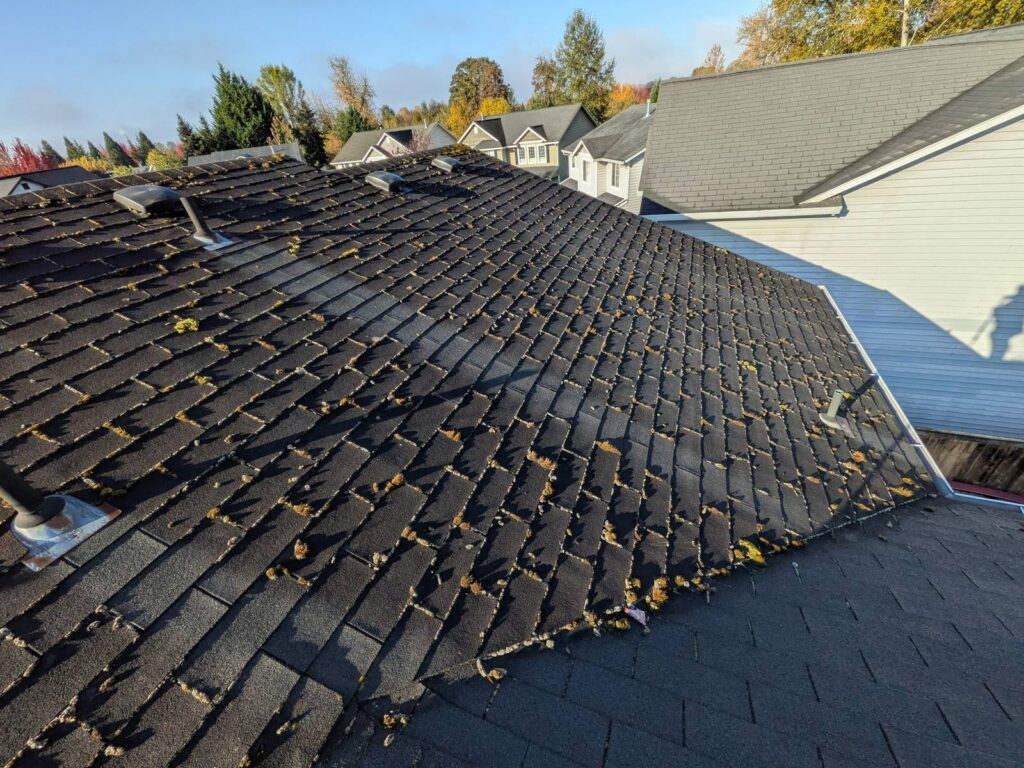
Moss on roof shingles before cleaning in Vancouver WA

How We Soft Washed Moss Off a 20-Year-Old Roof in Battle Ground, WA

If you live around Vancouver, Battle Ground, or Ridgefield, you’ve probably seen it on your own roof or your neighbor’s: little tufts of green and brown moss tucked into the seams between the shingles. It starts small. Then one day you look up from the driveway and wonder how long it’s been there.

See our Battle Ground roof soft washing page for the process and pricing.

That’s exactly what this homeowner in Battle Ground, WA was dealing with. Here’s how the job went, start to finish, with real photos Dakota took on the roof.

What we found on the roof

Moss growing in the seams of dark asphalt shingles before roof soft washing in Battle Ground, WA

Before: moss and debris packed into the shingle seams, heaviest near the lower edge.

This is a dark asphalt shingle roof that’s a little over 20 years old. When Dakota got up for a closer look, moss was growing along the gaps between the shingle tabs across the whole slope, and it was thickest down by the lower edge, where the roof meets a lower roof section. The growth was all organic: moss and algae.

The homeowner called us because they wanted to get more life out of their roof.

Why moss on a roof is worth dealing with

Southwest Washington’s long, wet season gives moss and algae plenty of time to settle into a roof. The dark streaks you see on many shingle roofs are usually algae, and the green patches along shaded edges are often moss. Left alone, moss holds moisture against the roof and can lift shingle edges over time.

It’s one of those jobs that’s easy to put off, because from the ground it just looks like a little “character.” Up close, it’s a sponge sitting on your shingles.

How we soft washed this roof

Step 1: A free on-site estimate

Every job starts the same way. We come out, look at the surfaces, recommend soft washing or pressure washing, and give you a quote.

Step 2: Low pressure, not high pressure

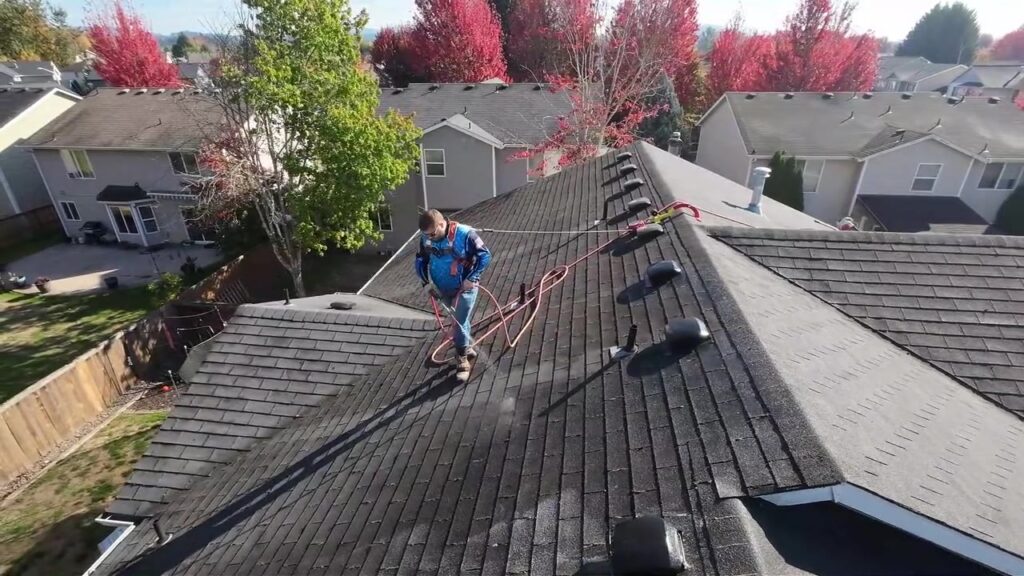
Mountain View technician in a safety harness soft washing an asphalt shingle roof, seen from a drone

Soft washing in progress. Low pressure, a cleaning solution, and a safety line.

This is the part people are most surprised by: we don’t blast roofs with a pressure washer. A strong stream can strip the granules that protect asphalt shingles and push water up under the layers.

Soft washing takes a gentler approach. We apply a cleaning solution at low pressure, give it time to work on the organic growth, and rinse with care. In the drone shot above, you can see the technician working from the ridge, tied off with a safety harness and line, with the hose running across the roof. On this roof, the moss also had to be brushed off, and that’s what took the most time: the job ran about two and a half hours from start to finish.

We also pay attention to everything around the house. At this home, a second crew member kept the plants below wet with water the whole time, so no overspray landed on them.

Brushing the moss off the roof sent a lot of it into the gutters, so we cleaned the gutters too before we wrapped up.

Step 3: The after

Clean dark asphalt shingle roof after moss removal and soft washing in Battle Ground, WA

After: the same roof, same vents and the same view of the neighborhood, with the seams cleared out.

Here’s the same slope after cleaning. Compare it to Photo 1: same roof vents, same neighboring houses in the background, but the moss that was packed into the seams is gone and the shingles look even and dark again.

One thing we always tell homeowners: heavier moss may keep loosening and washing away with the rain over the following weeks. So if you spot a few leftover bits after the job, that’s normal for soft washing. On this roof, no follow-up was needed, and the customer was very pleased with the result.

Another roof, same idea

Side-by-side before and after of a gray shingle roof with a brick chimney in Vancouver, WA, cleaned by roof soft washing

Soft washing a roof on another job in Vancouver, WA — same process.

Moss doesn’t only show up on one kind of house. This side-by-side is from a different job in Vancouver, WA: a gray shingle roof with a brick chimney, cleaned with the same process. In the before photo you can see moss running in lines along the shingle seams. In the after, those lines are gone.

Roofs aren’t the only thing we soft wash

We match the method to the surface. Roofs and siding get soft washed. Concrete, like driveways, walkways, and patios, is tough enough for pressure washing, and that force is what lifts embedded dirt and moss out of it. If you’re curious about the difference, we wrote a whole page on pressure washing vs. soft washing.

A lot of the homeowners who call us about a roof end up asking about the rest of the house too:

Owner Dakota Grindland and the crew serve homeowners in Vancouver, Camas, Washougal, Ridgefield, Battle Ground, and nearby neighborhoods. You can see all of them on our locations page.

Roof moss FAQ

How often should a roof be soft washed in Vancouver?

Many roofs in our climate do well with a cleaning every couple of years. Roofs in shadier spots often grow moss faster and may need attention sooner.

Will soft washing damage my shingles?

Soft washing is designed to clean without the high pressure that wears down shingles. It’s the low-pressure approach commonly recommended for asphalt roofs.

Is the cleaning solution safe for my plants?

We take steps to protect landscaping before, during, and after the job. Let us know about any delicate plants or garden beds so we can plan around them.

Why is there still some moss on my roof right after cleaning?

Heavier moss may keep loosening and washing away with the rain over the following weeks.

Ready to get the moss off your roof?

If your roof is starting to look like the “before” photo, we’d be happy to come take a look. You can also see our Battle Ground roof washing service. Estimates are free and on-site: we’ll look at your roof, recommend the right method, and give you a quote.

Request your free estimate or call or text Dakota at (360) 852-5589.

Get a free on-site estimate. Call or text (360) 852-5589.

Get a free estimate

(360) 852-5589