
Roof Cleaning & Moss Removal in Vancouver, WA: What Homeowners Should Know
If you own a home in Vancouver or anywhere in Clark County, there’s a good chance you’ve looked up at your roof and seen green. Maybe it’s a few tufts along the seams, maybe it’s a whole shady slope going fuzzy. Either way, you’re probably wondering if it matters, what to do about it, and whether pressure washing is the answer.
For pricing and service details, see our roof cleaning in Vancouver, WA page.
This guide covers why moss and algae love Clark County roofs, what soft wash roof cleaning actually does, how your plants are protected, and when it makes sense to call someone. If you’d rather see a real job start to finish, read how we soft washed moss off a 20-year-old roof in Battle Ground.
Why roofs in Clark County grow moss
Southwest Washington has a long, cool, wet season. From fall through spring, roofs here can stay damp for days or weeks at a time, and that steady moisture is exactly what moss and algae need.
A few things make it worse on a particular house:
- Shade. North-facing slopes and roofs under tall firs and maples dry out slowly. Those are almost always the first spots to turn green.
- Tree debris. Fir needles and leaves collect in valleys, behind chimneys and along the lower edge. That debris holds water and gives moss a place to start.
- Water running onto the roof. Downspouts that empty onto a lower roof keep that section wet long after the rain stops.
- Clogged gutters. When gutters back up, water sits along the edge of the roof instead of draining away.
Moss vs. algae: what you’re looking at
Not all roof growth looks the same:
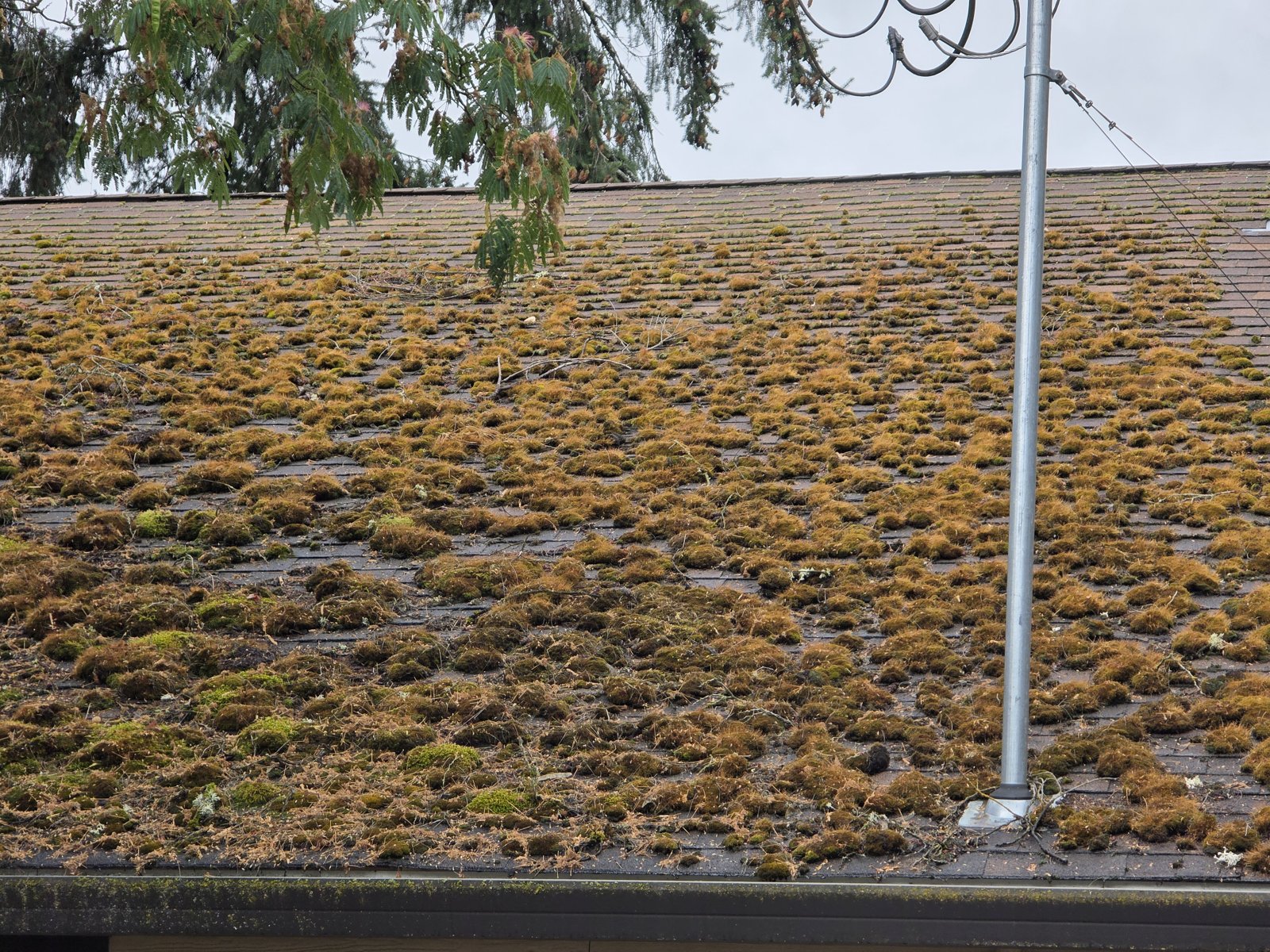
- Moss grows in raised green or brown clumps, usually along the seams between shingles and thickest along the lower edges and shady areas.
- Algae shows up as dark streaks running down the roof. It’s flat, so many homeowners mistake it for dirt or aging shingles.
- Lichen forms crusty, light-green or gray spots that cling tightly to the surface.
All three are organic growth, and all three respond to the same kind of cleaning.
Why moss on your roof is worth dealing with
From the driveway, a little moss can look harmless. Up close, it acts like a sponge. Moss holds moisture against your shingles, and as the clumps grow they can work their way under shingle edges and lift them over time. Moss and debris that wash off the roof also end up in your gutters.
Dealing with it early is usually easier than waiting until the whole roof is covered.
Why we don’t pressure wash shingle roofs
This is the most important thing to know before you hire anyone, or before you get up there yourself with a rented pressure washer.
High-pressure water can strip the granules that protect asphalt shingles and force water up under the layers. It can also make the roof dangerously slick for whoever is standing on it.
That’s why Mountain View Pressure Washing And Softwash uses soft washing on roofs. Soft washing uses low pressure and a cleaning solution that breaks down moss, algae and lichen. The solution does the work, not the force of the water. After it has time to work, the roof is rinsed with care. For a side-by-side look at the two methods, see our page on pressure washing vs. soft washing.
What to expect after a soft wash
Soft washing treats the growth at the root, but heavier moss doesn’t always vanish the same day. Some of it keeps loosening and washes away with the rain over the following weeks. If you see a few leftover bits after the job, that’s normal for soft washing.
Thick moss sometimes needs to be brushed off by hand as part of the job, and that loosened moss often lands in the gutters. Ask about gutter cleaning when you get your estimate. Our page on gutter cleaning in Vancouver explains what’s involved.
How your plants and landscaping are protected
Homeowners often ask what happens to the flower beds and shrubs under the roofline. Dakota protects plants and landscaping by pre-wetting them before cleaning, rinsing them during the cleaning, and rinsing them again after the job is done.
Keeping moss from coming back
No cleaning changes the weather, so in a shady, wet spot, growth can return over time. A few habits help slow it down:
- Keep gutters clear so water drains off the roof edge. See when to clean your gutters in Clark County.
- Clear fir needles and leaves out of valleys and from behind chimneys.
- Trim back branches that hang over the roof, if you can, to let in more light and air.
- Extend downspouts that empty onto lower roof sections so water isn’t sitting on the shingles.
When to call for roof cleaning
It’s a good time to get an estimate if:
- You can see green clumps along the shingle seams, especially on shady slopes or lower edges.
- Dark streaks are spreading down the roof.
- Your gutters keep filling with moss and shingle debris.
- You’re getting ready to sell, or you simply want to get more life out of the roof you have.
Roof work means ladders, height and slick surfaces, so it’s a job best left to someone with the right safety gear. Learn more on our roof washing in Vancouver, WA page. Owner Dakota Grindland serves homeowners in Vancouver, Camas, Washougal, Ridgefield, Battle Ground and nearby Clark County communities. See all of them on our locations page.
Roof cleaning FAQ
How much does roof cleaning cost in Vancouver, WA?
Our pricing page lists roof softwash starting at $495. Your exact price depends on the size, pitch and condition of your roof, so we give you a quote after a free on-site estimate.
Will soft washing damage my shingles?
Soft washing is designed to avoid that. It uses low pressure and a cleaning solution instead of a high-pressure stream, which can strip shingle granules and push water under the layers.
Why is there still some moss after my roof was cleaned?
Heavier moss can keep loosening and washing away with the rain over the following weeks. A few leftover bits right after the job are normal for soft washing.
Is roof soft washing safe for my plants?
Dakota protects plants and landscaping by pre-wetting them before cleaning, rinsing them during the cleaning, and rinsing them again after the job is done.
How often should a roof be cleaned in Clark County?
It depends on shade, trees and drainage. Roofs under firs or on north-facing slopes usually need it more often than sunny, open ones. Ask during your estimate.
Can I just pressure wash my roof myself?
We don’t recommend it. High pressure can damage asphalt shingles, and a wet roof is a dangerous place to stand. Soft washing with proper safety gear is the safer option.
Ready to get the moss off your roof?
If your roof is starting to look like the photos above, we’d be happy to take a look. Estimates are free and on-site: we’ll check the roof, recommend the right approach, and give you a quote.
Get a Free Estimate
Mountain View Pressure Washing And Softwash
Call or text Dakota: (360) 852-5589
Licensed & insured · 100% Satisfaction Guarantee
Mountain View Pressure Washing And Softwash · (360) 852-5589 · Serving Vancouver and Clark County, WA